Friday, June 21, 2013

Buyer's Guide: 

Style Manuals in U.S. English
   

Americans follow several style manuals.  To help you choose the best one for your purpose, here is my buyer’s guide.  I have no financial interest in any product, and the information below comes from decades as a business writer, journal editorial staffer, student, and professor.


The MLA (Modern Language Association) Handbook presents the style used in most high schools and in university humanities classes.  Software for generating MLA references is free on the Internet at many sites.


If you are editing books or papers for journals in the social sciences, you might choose either The Chicago Manual of Style 16th edition  or the Publication Manual of the American Psychological Association 6th edition (APA6; second printing or later).  


The Chicago Manual of Style is not an ideal standard for a business or a university classroom.  It includes two distinct systems of source notation: numbered superscripts and (Author, year).  Further, it was written by and for the staff of a large academic publishing house.  If your venue is a classroom, corporation, or association, you may have trouble finding answers to your style questions.  That is, the manual is arranged and indexed for editorial experts.  You must know the meanings of dagger, en-dash, run-in, and recto.  And you are paying for hundreds of pages of academic minutiae.

APA6 is friendlier to the teacher and student, but it is still written by editors who address published authors and reviewers.  It ignores the logistics of term-paper submission. 


For example, despite an enlarged and well-illustrated chapter on figures and tables, all of its examples of “table notes” presuppose that you reproduce tables in their entirety from a published source—requiring copyright information and permissions.  That chapter shows no examples of student-constructed tables that merely use some data from sources.  Such tables’ notes, I learn from the APA’s wonderful Style Expert blog, should simply include the citation(s) of your source(s), which you will of course expand, as usual, in your reference list.  I consult that blog regularly.


There are style manuals for every discipline: physics, chemistry, history, biology, etc.  And there is one for physicians: The American Medical Association (AMA) Manual of StyleBut when physicians and allied professionals teach, they normally require students to follow APA style, because the APA manual is so much easier to use.  The latest AMA Manual of Style (10th edition) weights 4.25 pounds (1.928 kg) and covers over 1,000 pages.  I have a copy and I consult it when anyone asks.  But, like The Chicago Manual, it is a book for editors.  If you must follow AMA style, learn to use the free Zotero.org application.  You can buy AMA software for $40, and there are free style sheets available.


You don’t need either Chicago or APA6 if you are in business, because you rarely list sources.  The most respected resource for U.S. business English is The Gregg Reference Manual.  It has recently appeared in 9th, 10th, and 11th editions, with changes that seem to me largely cosmetic and promotional.  All of those editions are good guides.  This book is complete and authoritative, and it is reasonably user friendly.  When I face questions about grammar or punctuation, I go to Gregg first.


Finally, think of the needs of journalists on assignment.  They need quick answers to questions about nations, politics, peoples, customs, and economics.  That kind of information is conveniently indexed in the 2011 and 2013 editions of The Associated Press Stylebook and Briefing on Media Law (AP).   For a browser of trivia like me, it is a delight.  And my friends in public-relations departments use it constantly.  But it is not a good guide for email, proposals, or term papers.  Its authors largely ignore both academe and corporate etiquette, and it follows the punctuation rules of journalists.


There are literally dozens of specialty style manuals. I have not even mentioned International Council of Medical Journal Editors ICMJE or Vancouver style  (accepted by AMA and widely used in Australia), Council of Biology Editors style
or the Microsoft Manual of Style for Technical Publications.  


If you contemplate buying a style manual, I’d be happy to confer with you.


Saturday, April 06, 2013

APA Style for Referencing Laws


Last October, I posted about antiplagiarism sites. But part of avoiding plagiarism is knowing how to credit your source correctly.

If you follow APA style, the Publication Manual (6th ed.) describes legal references on the Manual's pages 216-224. The APA follows the legal Blue Book or Bluebook. But the APA's nine pages of legal guidelines leave out such sources as state bills that did not become statutes: unenacted legislation.   

For the text of unenacted legislation, I found a library guideline.
It seems that that reference needs four elements: 
  • The name of the bill
  • Its number (H for house, S for senate), including section number, if any
  • The official name of the State's legislative body, including the session, if specified
  • The year 
Fictitious Example:
Protection for Motorcyclists and Passengers, H 3409 section 32. South Dakota Legislative Assembly, Session 1, 2004.
The corresponding citation, in the text, would have two elements: the name of the law and the year.

For the many other government documents we must sometimes reference, I found a ten-page guide.  It came from a high school in Idaho, supplied for a senior project.   

Arizona State University has a page with a "citation engine" that will accept your typed-in information and generate a reference--in APA style or MLA style.  

Friday, January 11, 2013

Dr King as Business Writer: Restrained Power

--> Scholars have anatomized Dr. Martin Luther King, Jr.’s peerless speeches and other public prose.  Little attention has gone to Dr. King as business writer.  

Below is a letter he wrote in December 1955 to the National City Lines. It persuaded them to send a negotiator to Montgomery, Alabama. The business goal was to change the racist policies of their affiliate, Montgomery City Lines.

I have put all the verbs in italic type.

8 December 1955   

The National City Lines, Inc.
616 South Michigan Ave.
Chicago, IL

Over a period of years the Negro passengers on the Montgomery City Lines, Inc. have been subjected to humiliation, threats, intimidation, and death through bus driver action.

The Negro has been inconvenienced in the use of the city bus lines by the operators in all instances in which the bus has been crowded. He has been forced to give up his seat if a white person has been standing.

Repeated conferences with the bus officials have met with failure.  Today a meeting was held with Mr. J. H. Bagley and Attorney Jack Crenshaw as representatives of the bus company, and Mayor W. A. Gayle and Associate Commissioners Frank Parks and Clyde Sellers. At which time as an attempt to end the Monday through Thursday protest, the following three proposals were made:
1. Courteous treatment by bus drivers.
2. Seating of Negro passengers from rear to front of bus, and white passengers from front to rear on “first-come-first serve” basis with no seats reserved for any race.
3. Employment of Negro bus operators in predominantly Negro residential sections.

The above proposals, and the resolutions which will follow, were drafted and adopted in a mass meeting of more than 5,000 regular bus riders.  These proposals were denied in the meeting with the city officials and representatives of the bus company.

Since 44% of the city’s population is Negro, and since 75% of the bus riders are Negro, we urge you to send a representative to Montgomery to arbitrate.

The Montgomery Improvement Association
The Rev. M. L. King, Pres.
The Rev. U. J. Fields, Sec’y

Until the end, 75% of verbs are in the passive voice.*  Passive verbs create a tone of objectivity and avoid blame.  

Dr King surrounds his passive verbs with nouns that, similarly, subdue outrage and instead pursue the letter's business goal.   He brackets racist behavior inside the nouns “humiliation, threats, intimidation, and death” and where he could have named the perpetrators, he substitutes the masterful understatement “bus driver action.”  

Then, in this business letter’s very last sentence, his power emerges.  We hear the ringing, personal monosyllables of “we urge you.”   

In other words, following the letter's restrained description of racism, its businesslike litany of implacable white leaders, and its equally businesslike statistics of the firm's African American customer base, Dr. King hits home.

Of course, the unseen dimension of a business letter is its choice of recipient.  Dr. King knew that when you are ill-served, you go to the firm's owner. 

I could go on to elaborate how Dr. King used his mastery of English in the format, the length, and every other aspect of this letter.  But you get the idea.  


*One active verb (have met) is there to frame the noun “failure,” which tactfully heads off the question of who failed whom.  The second active verb “has been standing” is scarcely avoidable; being intransitive, this meaning of "to stand" has no passive form.  "Will follow" is active voice; it promises proposals without specifying who will send them.

Tuesday, November 06, 2012

Writing a Difficult Letter? See Your Library's Page

When did you last explore your public library's web page?  Library membership is, of course, free.  And members get $$$ resources free.

Let's say you must write a difficult letter, warning an employee about possible discipline. You want it to be legally correct.  Go to your library's home page, sign in with the barcode number on your library card, and click on Online Resources:

At my library's site, I found free access to commercial databases, including Consumer Reports, the Chicago Tribune, and an astonishing 1,555 legal forms I can use. 
What can you find for free online at your public library?

Tuesday, October 30, 2012

Don't Use Online Proofreaders or Plagiarism Checkers

Warning.

Do not use online "free" or "free trial" sites that promise to proofread your writing or check for plagiarism. 

Virtually all of them require you to click "Agree."  In the fine print of the agreement, you give them rights to your document.  And they have an affiliate that sells papers to students.

Here is some typical "fine print" from dictionary.com's "proofreader free trial":

By making any material or information available through the Site, you automatically grant to Dictionary.com a worldwide, royalty-free, perpetual, irrevocable, and non-exclusive right and license to use, reproduce, modify, adapt, publish, translate, distribute and sublicense any such material or information (in whole or in part) and/or to incorporate it in other works regardless of form, media, or technology. By making any material or information available through the Site, you also grant to users other than yourself the right and license to access, view, store, or reproduce your material and information for that user’s personal use.

Tuesday, August 28, 2012

Flawed Guide to Style


Dictonary.com has added advice about punctuation, capitalization, how to address people, etc. 

This advice is accessible here.  Sadly, those pages are written in a British style.  Lists  use single quotes with commas outside the quotes.  The writers use “e.g.” liberally, without explaining what e.g. means (it means for example), and without adding the comma that should follow in U.S style.

The best style guide is still the back of a good U.S dictionary, such as Merriam-Webster’s Collegiate. Do not buy it today; there will be a new edition in 2013.

Better still, you can get complete advice about grammar, punctuation, usage, and style from the famous Gregg Reference Manual.)

Monday, July 02, 2012

Computer-Graded Essays


By now, everyone knows that the college-entrance tests require that students write essays.  Those essays can now be scored by any one of many software programs. 

One such program, Educational Testing Service's e-Rater, is described by Michael Winerip in a New York Times article.  His informant, an MIT writing instructor, easily trips up the program.  After all, it can only base its evaluation on "surface" features of the essay.  It gives higher scores to
  • Longer essays
  • Essays that use formal words such as however and moreover
  • Longer sentences
  • Longer paragraphs
  • Essays without sentences that begin with Or or And.
According to Winerip, defenders of the software argue that if you are smart enough to "game" it, you deserve the high score it gives.  They acknowledge that a student could excel by writing nonsense and/or using impressive words, long sentences, and long paragraphs.  The software cannot check facts or notice silliness.  Defenders add that, for graduate-school entrance exams, the software is "backed up" by human raters. 

Essay-scoring software is objectively discussed by another college prof who lays out the pros and cons and offers an up-to-date bibliography.

As e-Rater and its competitors gain popularity, will writing instructors encourage the high-scored characteristics? 

If so, would these longer documents with fancier words add up to obfuscation?  And if pedagogy and product changed to suit the software, would anyone notice? 

Thursday, June 14, 2012

Writing for Grad School


So many people today are earning a graduate degree.  Grad school requires writing, and in disciplines like nursing and business, papers must follow APA (American Psychological Association) style. 

Rosemary Camilleri teaches a one-day introduction to analyzing and writing a grad paper that gets you the best grade possible.

Intro to Grad Writing and APA6    September 14, 2012, 8:30 am to 4:30 pm
Lots of practical tips, interaction, and a handout that will guide you as you write.

$175 payable to UIC        Earns 7 hours of CEUs (continuing ed units).
Class meets at the College of Nursing, 845 South Damen Ave, Chicago, IL.
To register, go to http://uic.edu/nursing/ihi and, in the News & Events window, scroll way, way down to 2012 Graduate Writing Courses.

For details on the class's content, email Rosemary.


Wednesday, May 23, 2012

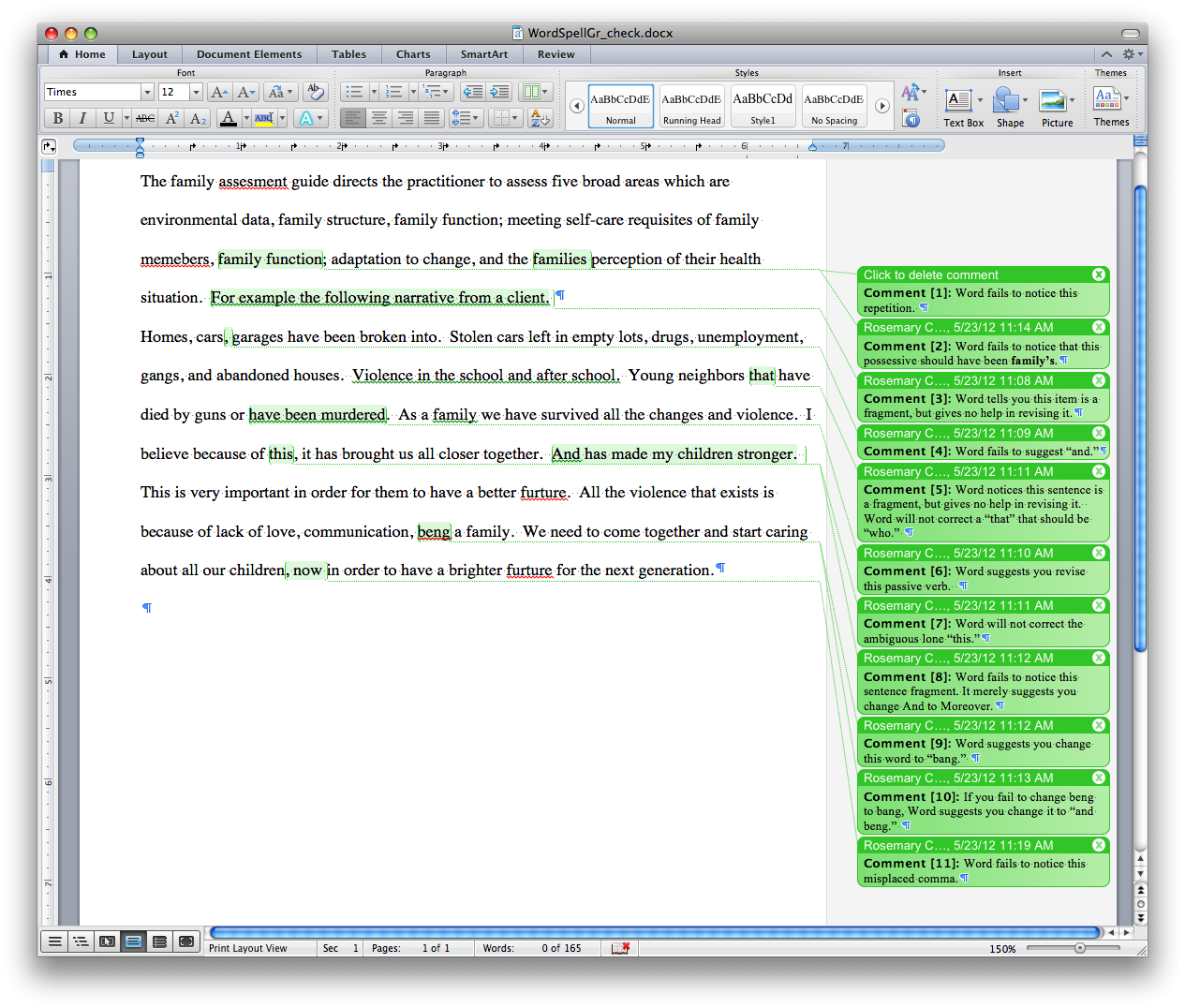
Microsoft Word Partially Checks Spelling and Grammar

In the passage above, I deployed Microsoft Word (Mac) 2010's spelling and grammar checks, but they failed at 11 places.  If you would like a more legible copy of this illustration, just email me at rosemary@WritingSems.com.

Do use spelling and grammar checks. They are important.  But remember that they are not enough.

Thursday, April 19, 2012

First Person in Academic Writing

Dr Christine Webb has published a scientific paper in which she argues effectively that researchers should use the first person (I, my, we, our).

In helping professions, writers have tried to seem objective by writing in the third person: they, it, he, she.  But the impersonal pretense belies the real nature of knowledge, which we all know is socially constructed.

Of course, a social science or nursing paper should not read like The Confessions of St. Augustine.  Most sentences should not start with "I." 

And when I write about evidence I gained by reading, or I describe an objective fact that someone else could replicate, I use the third person:

Of these heart patients, 16 recovered;
After six minutes, the lead melted;
U. S. children with asthma use inhalers;
The emerald ash borer kills ash trees.

But when I record a fact that would differ if someone else did it, I should use the first person:

I hypothesized that...
My previous research had shown that...
This patient's mother approached me privately and said ...

In such cases, anything else is at best less accurate and at worst deceptive.

Wednesday, March 21, 2012

What Is an Idiom, and Why Does It Matter?

“When I worked at BigTech, we pushed the envelope on real-time global trading.”  

Push the envelope is an idiom because you can define push and envelope and still not understand the phrase. 

Idioms are not always explained in a U.S. dictionary such as Merriam-Webster’s Collegiate or the American Heritage Dictionary.  Yet learning idioms is vital to newer Americans, who benefit from an advanced learner’s dictionary (ALD).  In fact, these dictionaries may well deserve a place on everyone’s desk.

In job interviews, if applicants misuse an idiom, they may disqualify themselves.  If I misuse an idiom on my CV, résumé, or website, my prestige will plummet.   And graduate students may be writing to a higher standard, so they might appreciate a resource that builds their confidence.  Further, Americans who come from Scotland or Nigeria may want to know which British idioms (such as ticking over) puzzle Americans.

ALDs and learner’s dictionaries (LDs) represent the same category, and you choose a level from basic to advanced. The category includes editions from

Merriam-Webster available as an app via iTunes
Oxford also available as an app

The Cambridge Intermediate LD is even searchable online.

Before you buy an ALD, you might want to look at a web page by Tomasz P. Szynalski.  He has exhaustively compared five of these dictionaries, not including the Merriam-Webster’s.  He finds no clear winner.  Your choice may depend on whether you will use the dictionary online, as a book, or as an app or DVD.

As always, I have no financial interest in any of the products mentioned here.  I currently own the Cambridge ALD, and I’m contemplating adding a Merriam-Webster’s and a Longman to my collection.   New idioms appear often, and, sadly, my Cambridge ALD (2003) does not include “push the envelope.”

Thursday, February 23, 2012

In the Plain Writing Act of 2010, Congress ordered the federal government to write clearly.  But few Americans realize that we have had plain-language executive orders, agency guidelines, and a website at least since the Clinton Administration.  Why are we still reading and writing dreck?

The Plain Writing Act resulted in updated federal guidelines that we can all use to write clearly. They live at a fine website.  

Moreover, the Securities and Exchange Commission (SEC) has long enforced plain-English standards when companies disclose information to investors.  You can download the SEC's own 83-page "Plain English Handbook.” 

And the federal agency that runs Medicare (Centers for Medicare & Medicaid Services or CMS) has published its own “toolkit” for writing clearly and inclusively.   This toolkit advises us how to design a document and collect feedback before we publish; and it warns us that readability formulas do NOT ensure readability.  Bonus: It even helps us write appropriately to older adults and people from other cultures.

But if you scan any of these guidelines, you will recognize most of them from high school, if not grade school, English.  They reflect common sense, such as
·      Write short sentences,
·      Use active-voice verbs,
·      Write short paragraphs,
·      Use words that your audience knows, and
·      Test your document with its audience before you publish. 

Why, after decades of good advice, do we still write impressive but ambiguous documents?  Does bafflegab still lure us with the power of avoiding readers who criticize because we avoid readers who understand?

Years ago, I helped a famous professional person write a document.  I cut it drastically and transformed key noun actions into active verbs.  I kept the nouns consistent, and topic sentences led most paragraphs.  The author gave the result to another professional who made suggestions; then I received the resulting document for a second round.  It was again long and inflated; evidently, inflation spelled prestige.

I gave up. 

Today, I hope, I would persist.  I would keep on editing for clarity until the author fired me.  But I wonder.  When will clear English be prestige English?

Flesch Readability Index:  56.5 
Grade Level: 8th grade, 6th month

Wednesday, February 01, 2012

Dr. King and the Topic Sentence

Dr King did not read his speeches; he spoke them.  So when we read them, someone inserted the paragraph breaks.  But Dr. King made it easy.

Dr. King started each chunk of his speech with a main idea, and then he elaborated it.  In written form, his speeches exhibit nearly perfect paragraphs, each beginning with a “topic sentence.”  This pattern is an amazing feat of rhetorical ability.

On Dr King’s Day in 2012, I studied one of his speeches (as is my custom). They are all available to us at http://mlk-kpp01.stanford.edu/index.php/encyclopedia/documents_contents   I chose his April 3, 1968, speech, I’ve Been to the Mountaintop.  

This speech’s point sentence was  “Strangely enough…‘…in the second half of the twentieth century, I will be happy.’ ”

Here’s how the next paragraphs begin:

Now that’s a strange statement to make because the world is all messed up.  [Rest of paragraph illustrates the mess.]

And another reason I’m happy … demands didn’t force them to do it.  [Rest of paragraph: how demands force us to protest nonviolently.]

I can remember … Negroes … scratching where they didn’t itch and laughing when they were not tickled.  [Rest of paragraph: we work toward the opposite of that unnatural behavior.]

Now what does this mean in this great period of history? It means that we’ve got to stay together.  [Rest of paragraph: how staying together foils white power.]

Secondly, let us keep the issues where they are. The issue is injustice.  [Rest of paragraph: injustice.]

When I write paragraphs, I try to announce a topic sentence and then support it.  To do so reliably, I must work retrospectively.  I draft the document first; then I go back and relocate or add the topic sentences. 

Dr. King, on the other hand, did so many things brilliantly.  He told moving stories.  He verbally embraced and emboldened his audience.  He told the truth, but always in love.  And, intellectually, his speeches could announce a topic, and support it, and move smoothly to the next. 

He made it seem easy.

Each time he spoke, he built, in the air between him and his audience, a structure so perfect it can still instruct us today.