Thursday, February 23, 2012

In the Plain Writing Act of 2010, Congress ordered the federal government to write clearly.  But few Americans realize that we have had plain-language executive orders, agency guidelines, and a website at least since the Clinton Administration.  Why are we still reading and writing dreck?

The Plain Writing Act resulted in updated federal guidelines that we can all use to write clearly. They live at a fine website.  

Moreover, the Securities and Exchange Commission (SEC) has long enforced plain-English standards when companies disclose information to investors.  You can download the SEC's own 83-page "Plain English Handbook.” 

And the federal agency that runs Medicare (Centers for Medicare & Medicaid Services or CMS) has published its own “toolkit” for writing clearly and inclusively.   This toolkit advises us how to design a document and collect feedback before we publish; and it warns us that readability formulas do NOT ensure readability.  Bonus: It even helps us write appropriately to older adults and people from other cultures.

But if you scan any of these guidelines, you will recognize most of them from high school, if not grade school, English.  They reflect common sense, such as
·      Write short sentences,
·      Use active-voice verbs,
·      Write short paragraphs,
·      Use words that your audience knows, and
·      Test your document with its audience before you publish. 

Why, after decades of good advice, do we still write impressive but ambiguous documents?  Does bafflegab still lure us with the power of avoiding readers who criticize because we avoid readers who understand?

Years ago, I helped a famous professional person write a document.  I cut it drastically and transformed key noun actions into active verbs.  I kept the nouns consistent, and topic sentences led most paragraphs.  The author gave the result to another professional who made suggestions; then I received the resulting document for a second round.  It was again long and inflated; evidently, inflation spelled prestige.

I gave up. 

Today, I hope, I would persist.  I would keep on editing for clarity until the author fired me.  But I wonder.  When will clear English be prestige English?

Flesch Readability Index:  56.5 
Grade Level: 8th grade, 6th month

Wednesday, February 01, 2012

Dr. King and the Topic Sentence

Dr King did not read his speeches; he spoke them.  So when we read them, someone inserted the paragraph breaks.  But Dr. King made it easy.

Dr. King started each chunk of his speech with a main idea, and then he elaborated it.  In written form, his speeches exhibit nearly perfect paragraphs, each beginning with a “topic sentence.”  This pattern is an amazing feat of rhetorical ability.

On Dr King’s Day in 2012, I studied one of his speeches (as is my custom). They are all available to us at http://mlk-kpp01.stanford.edu/index.php/encyclopedia/documents_contents   I chose his April 3, 1968, speech, I’ve Been to the Mountaintop.  

This speech’s point sentence was  “Strangely enough…‘…in the second half of the twentieth century, I will be happy.’ ”

Here’s how the next paragraphs begin:

Now that’s a strange statement to make because the world is all messed up.  [Rest of paragraph illustrates the mess.]

And another reason I’m happy … demands didn’t force them to do it.  [Rest of paragraph: how demands force us to protest nonviolently.]

I can remember … Negroes … scratching where they didn’t itch and laughing when they were not tickled.  [Rest of paragraph: we work toward the opposite of that unnatural behavior.]

Now what does this mean in this great period of history? It means that we’ve got to stay together.  [Rest of paragraph: how staying together foils white power.]

Secondly, let us keep the issues where they are. The issue is injustice.  [Rest of paragraph: injustice.]

When I write paragraphs, I try to announce a topic sentence and then support it.  To do so reliably, I must work retrospectively.  I draft the document first; then I go back and relocate or add the topic sentences. 

Dr. King, on the other hand, did so many things brilliantly.  He told moving stories.  He verbally embraced and emboldened his audience.  He told the truth, but always in love.  And, intellectually, his speeches could announce a topic, and support it, and move smoothly to the next. 

He made it seem easy.

Each time he spoke, he built, in the air between him and his audience, a structure so perfect it can still instruct us today. 

Saturday, January 07, 2012

The "However" Sandwich


Too often we all see sentences mispunctuated like these:

1.  WRONG He arrived 15 minutes late, however, he found a seat.
2.  WRONG He arrived 15 minutes late, however he found a seat.

Each of these sentences consists of an independent clause, then the conjunction however, and then another independent clause. 

Rule:  When however is sandwiched between two independent clauses, it requires a semicolon either before or after it—usually before.

Why?  Because however is one of the conjunctions that may either begin or end the clause.  
Example:
3. “My work is like a diary,” Picasso told me, and I have taken him up on this.  One has to tread carefully, however.  Diaries are nonetheless interesting for embroidering upon the truth.  (House & Garden magazine, March 1991, p. 28)

The second sentence ends, quite correctly, with “however.”  The period could (also correctly) have been a semicolon.

If however appears between two independent clauses, the reader needs to know whether it ends the first clause or begins the second one. This information is provided by the semicolon:

4.  CORRECT   He arrived 15 minutes late; however, he found a seat.

5.  ALSO CORRECT:  He arrived 15 minutes late.  However, he found a seat.

Other “two-direction” conjunctions or conjunctive phrases include therefore,
consequently, in fact, and of course. 

© 2012 Rosemary Camilleri. All rights reserved.

Wednesday, December 21, 2011

They Say, I Say

Gerald Graff and Cathy Birkenstein have published a book, They Say I Say: The Moves That Matter in Academic Writing. It has received positive reviews and a not-so-positive review.


My review is positive.  Novice writers must start somewhere, and They Say, I Say lays a good foundation.  Scholars expect certain “moves” that signal the accepted parts of an argument.  To execute those “moves,” academic writers can start by structuring arguments around certain phrases and clauses. Below are some clauses that I use. 

Move 1:   Announce consensus—a kind of “they say.”
It is widely believed that
Today, most people believe that…
Normally, one would expect that…
Experts in [a discipline, such as social work or French literature] have shown that…
Snow & Crow (2011) have demonstrated that    [Cite the appropriate research]
Theory X predicts that…

Move 2, usually right after Move 1:   Announce the contrast that points toward your paper’s thesis or "point."

However, there is some evidence that
But two very recent studies suggest that
Yet no research has yet tested whether
On the other hand, many practitioners find that
However, in the case of X,
Yet this current research fails to examine/answer
However, no studies have investigated the case of
On the one hand, every X wants to…   On the other hand, no X wants to…
Currently, theorists [or researchers] are divided; some believe X, while others hold that [not X]. 

Move 3  Announce your point.

Thus the purpose of this [paper, research, study…] is to
Therefore the present study will test whether


Move 4   Review the literature to provide a fuller context for your own research question.
            Here the trick is not so much clauses as verbs.  I can send you a list of verbs that bring lit reviews to life—verbs such as posit, maintain, suggest, contend, theorize, refute, etc.

Move 5, usually later in the paper:  Acknowledge arguments that rival your own.

This result seems to contrast with the findings of Snow & Crow (2011), perhaps because
Swallow & Spring (2011) disagree, asserting that …  This apparent contradiction could arise because
Our novel result could be explained if

Move 6   Later in the paper: Acknowledge limitations; thus you preempt attacks.


The present study is limited by
This research has several methodological limitations:
We acknowledge certain limitations of this research design:

Move 7   Conclude with a “Big Picture” ending.

This study has several implications.
If this study can be replicated, it would imply that
A next research question might be, “…..?”
How can we generalize this result?
Based on these results what larger problem can we solve?
This study may point to the notion that
Future researchers might well ask
Ultimately these results, if substantiated, may mean that X should

Wednesday, November 23, 2011

Publish or Perish? Writers Accountability Groups


If you need to write for your job, you probably have trouble starting or finishing a writing project.  Academic writers face especially tough hurdles: urgent priorities compete for their time.  Many such writers find that a support group speeds their projects.   

Experience shows you must want such a group, choose motivated members, and stay accountable when you feel like hibernating instead.  If you are an academic writer, don’t choose a group of journalists or fiction writers.  For joining or starting your own Writers Accountability Group, here are some tips: 


Spiritedwriter is a site with a religious tone.  It supplies practical steps to setting up a Writers Accountability Group.

Don’t be fooled by the post’s title, “Shut Up and Write.”   This longish article by Kerry Rockquemore argues that you deserve and can find (start?) a writer’s accountability group.

A writer named Bridget Cowlishaw has started a Writers’ Accountability Group on Facebook. You don’t have to join this one. You could start your own, using the group options in Facebook.


At women-on-writing, this newsletter, The Muffin, posts inspiration and writing tips.  Most of these people are freelance authors and journalists, but this post includes links to other writers’ groups.

Sunday, November 13, 2011

I Love This Guy

Britisher Michael Quinion writes a blog called World Wide Words, about English in our global age.  I recommend you check out his blog at this link. 
Michael has an international network of informants.  From World Wide Words, here are some gems.

  • Sally Springett told us of a letter to a columnist in the Rochester Democrat and Chronicle of New Jersey, dated 28 May: “Dear Edith: I found a multi-unit house with four tenants for sale.”
  • A juxtaposition of links on the BBC news website on 28 May struck Robin Dawes as unfortunate: Bin Laden Killed | William and Kate.
  • A paragraph in a church newsletter from Orland Park, IL, reminded Richard Olson of Jonathan Swift’s A Modest Proposal: “The first Saturday of every month we will be cooking and serving 60 homeless in Roseland.” It reminded me of a James Thurber quip about using verbs; a hostess remarked, “In this house, we can sleep 18 but we can only eat 10.”
  • Harvey Wachtel contributes an advertisement in the New York Metro issue for 11 May. It was for Water’s Edge condos on the Rockaway peninsula of Long Island: “Each residence has a private sodden backyard.”
  • “Mohammed Ali of the Libyan Salvation Front and a Tripoli resident, who spoke on condition of anonymity for fear of reprisals ...”


Here's Michael's copyright information: 

World Wide Words is copyright © Michael Quinion 2011. All rights reserved. You may reproduce this e-magazine in whole or part in free newsletters, newsgroups or mailing lists online provided that you include the copyright notice above. You need the prior permission of the author to reproduce any part of it on Web sites or in printed publications. You don’t need permission to link to it.

Monday, October 10, 2011

Bad Folklore


Writer’s block can freeze your productivity.  One study (Rose, 1984, p. 72)  suggests that writer’s block thrives when writers labor under false rules.  I call these rules bad folklore. 

Over the years, students have reported rules they claimed their writing teachers enforced.  Below are the top ten.  All are wrong … bad folklore that hobbles good writers.


  1. Never begin a sentence with And or But.
  2. Never begin a sentence with Because or However.
  3. Never begin a sentence with a preposition (Sheesh.  How does the Book of Genesis begin?)
  4. Never begin a sentence with “The.” (Yes, someone actually believed that!).
  5. No two sentences should begin alike.  (Laboring to obey this rule will cripple any writer.)
  6. Vary your sentence length and structure to keep readers’ interest. (Nonsense.  Good writing bases sentence length and structure on the old-new rule and its corollaries—never on arbitrary variation.)
  7. Never end a sentence with a preposition. (Even the Brits scorn this old chestnut.)
  8. Write the introduction first.  (No, it is usually faster to draft the document first.  Ideas for good first paragraphs often pop up late in the draft, as you summarize.)
  9. Edit sentences as you draft.  (Derails your train of thought and saps your confidence.)
  10. Write your thesis before you draft the paper. (While an initial thesis may help you focus, good writers learn as they write. I often “post-write” a better thesis than the one I had prewritten.)

Thursday, September 22, 2011

Writing a Résumé—or a Performance Evaluation

Writing your own résumé is hell.  And nearly everyone overwrites and overexplains.  These facts I know from experience with dozens of job seekers.

Writing a performance evaluation isn't any fun, either. 

Here are some resources that might help:

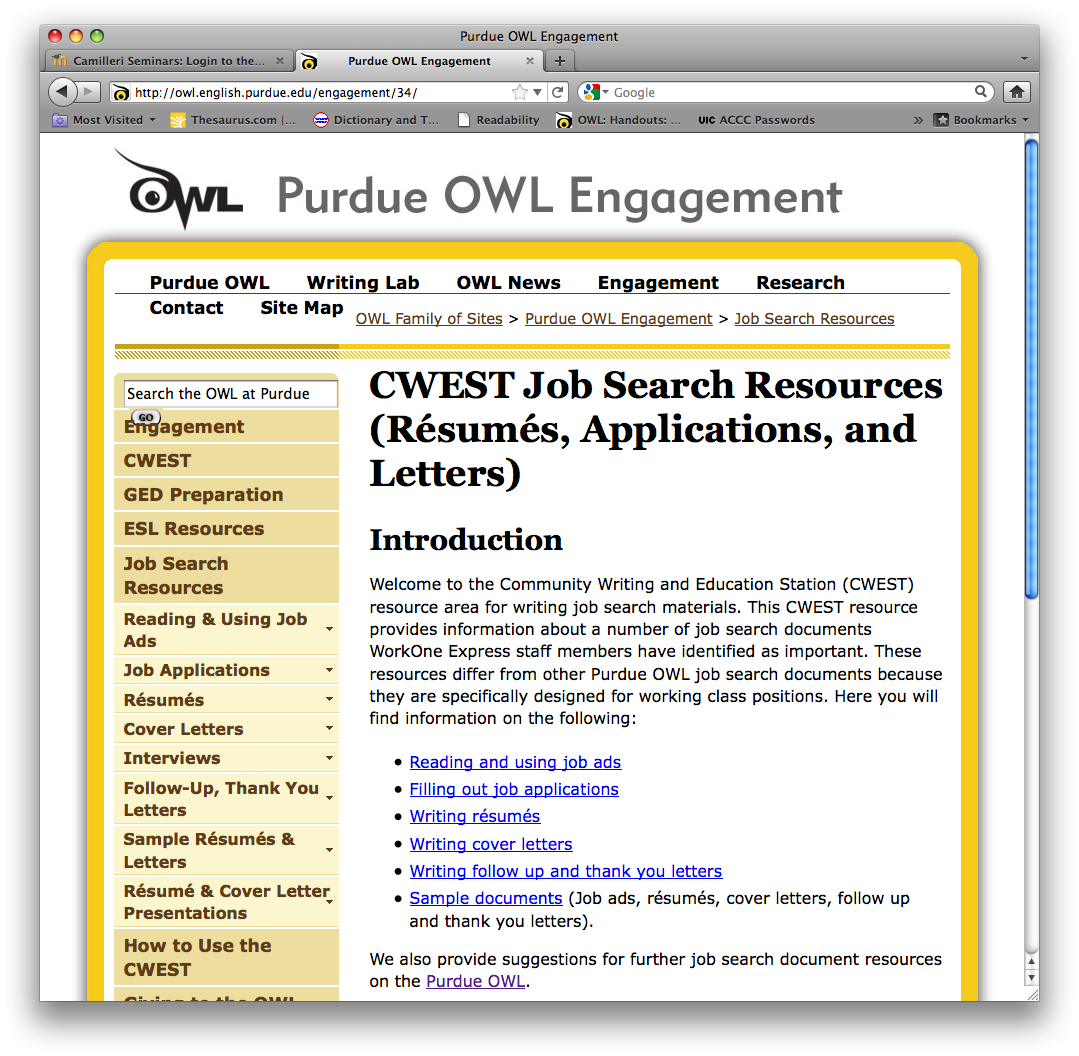
Purdue's famous Online Writing Lab (OWL) helps immigrants and job seekers with its Community Writing and Education Station (CWEST). CWEST offers advice and sample documents for writing resumes (or do you write résumés?) and cover letters.

Résumé writing requires verbs, which abound in the two books below.  They are written not for you but for the manager who must review performance. 


There's even a book about how to write a negative review:

Sandler, C., and Keefe, J.   Fails to Meet Expectations: Performance Review Strategies for Underperforming Employees.  281 pages. Adams Media; Avon, MA.

Wednesday, August 24, 2011

Shop for a Dictionary


I have long preferred the Merriam-Webster's Collegiate Dictionary. For educators I've recommended the picture-full American Heritage College Dictionary.  But I wonder whether I'm right.  And what about comparing online dictionaries?

In 2009, author Yi-Ling Chen-Josephson reviewed dictionaries for Slate magazine; see her review here.  I was happy to see that she agrees with me, rating the Merriam-Webster's just slightly higher than the American Heritage.  Of course, I must use the Merriam-Webster's when I teach APA style because APA cites it as the authority.  


Chen-Josephson compared printed dictionaries. What about online ones? I use the Merriam-Webster's online at http://m-w.com because of course I can click on [pronunciation] and hear the word. The American Heritage does not have its own site, but it seems to be available, possibly abridged, at thefreedictionary.com.


Speaking of online, I prefer dictionary.com over yourdictionary.com.  I like macmillandictionary.com if I want to toggle between British and US English. It also has a much cleaner site.

But for you Yanks, dictionary.com lists information from these dictionaries: first Random House Dictionary (2011), then World English Dictionary aka the Collins English Dictionary, 10th edition (2009).  For etymologies (word origins), it cites information from something called the Online Etymology Dictionary (2010) by Douglas Harper.  There are no links directly to online versions of these dictionaries, so no way to check the sources.  


Related to dictionary.com is thesaurus.com, which I use because it contains many more words than the Merriam-Webster's thesaurus.  It draws from many thesauruses (or do you say thesauri?)


A competitor is yourdictionary.com. It failed my test.  Initially it looks great because the page is uncluttered.  And it purports to offer many related resources, such as an ESL page and examples of the word used in sentences.  But the ESL list of links led to many dead ends or under-construction sites.  And the algorithm used to generate "sentence examples" is horrible. For the word "laboratory," its first seven sentence examples are:
  • Laboratory testing in ukas accredited laboratory testing in ukas accredited laboratory [ based in kilsyth office ] .
  • The company operates a state-of-the-art water testing laboratory in huntingdon.
  • Laboratory experiments.
  • He runs a food microbiology service and the hca microbiology laboratory.
  • Laboratoryhas many well-equipped laboratories for the teaching of forensic science.
  • Laboratorymical and biological science graduates currently find work in analytical laboratories.
  • Laboratoryl submitted his et barthelemy with july villari e. l v the live further awayif in physics laboratories he did this.


Saturday, August 06, 2011

Does your page reflect your age?

Which of those pages looks readable?  I don’t mean, “Do you understand what they say?” I mean, “Which page layout can you follow?”

Your answer may reflect your generation.  For more examples, look here.

Fifteen years ago, I watched my godson (age 9) read a Nintendo Power magazine.  To me, the words and the pictures seemed to be thrown onto the page.  Just looking at the salad-like layout, I squirmed and looked away. 

I knew Bill didn’t love reading.  I asked him how he could read Nintendo Power pages. He said, “Don’t you know how to read comic strips?  This page works the same way.” 


Today’s Nintendo Power (above) has text that is laid out a bit more like The New Yorker.  But how does the text relate to the pictures?  In what order should I look at the pix? In them, I see a "3" and a "2," but what do the numbers mean?  And have you looked at a book-format Japanese anime?

Today, language pundits speculate whether “texting” will ruin written English.  But no one is asking whether "screening" changes our eyes.  Computers (games, websites, and blogs) instill their layout expectations into human brains.  Does the next generation read a different-looking page than we older folks do? 

When it comes to reading pages, I’m a top-down, left-to-right person.  I want each picture “tied to” its caption.  

I bring format expectations to what I read. 

But so does my godson.  And he’s out of college now.  Will his generation reinvent the page?

Friday, July 15, 2011

I present a theory …?

The First Person

I could write impersonally: A theory is presented …
Or I could write personally: I/we present a theory …   
Which style informs you better?

Suzette Haden Elgin suggests that the safest mode of speech is “computer mode” —speaking without I, you, or opinions.  Thus, Elgin reports, computer mode is preferred in science writing.  And indeed, the American Medical Association Manual of Style, 10th edition, page 320, prefers not “we did X” but “the author(s) did X.”

But some journals, such as Health Care for Women International, explicitly require first person pronouns (I or we) and active voice verbs.  Further, the Publication Manual of the American Psychological Association, 6th edition, even encourages the use of I and we (page 77).

For scientific writing, which “voice” below would you choose?

Active voice with personal pronoun: I studied or We studied.
Active voice with third-person: The author studied.
Or passive voice (no personal pronouns): X was studied. 
Or action in a noun (no pronouns):  A study was undertaken.

On the question of personal pronouns in science or business, here are the views of several sources:

Harwood N.  (2005). ‘We do not seem to have a theory … the theory I present here attempts to fill this gap’: Inclusive and exclusive pronouns in academic writing.  Applied Linguistics 26, 343-375. 
         In business, physics, economics, and computer science, Harwood finds I, we, and us used, but with very different effects. There is a spectrum from the risky I as originator to the consensus-building we/us that actually effaces the writer.  (Incidentally, Harwood uses “I” liberally.)  He concludes that acceptance of these first persons varies with the “corpus” or discipline.

Kuo, C-H. (1999). The use of personal pronouns: Role relationships in scientific journal articles. English for Specific Purposes 18, 121-138.  In science, Kuo found we is far more common than I, and, used either inclusively or exclusively, we strategically positions a writer’s statement.

Netzel, R., Perez-Iratxeta, C., Bork, P., & Andrade, M.A. (2003). The way we write: Country-specific variations of the English language in the biomedical literature. European Molecular Biology Organization [EMBO] 4, 446-451.   In biomedical literature, compared to English written elsewhere, US English has a high proportion of I/we personal pronouns and low proportion of passive verbs.  In the same corpus, US English is high in both sentence length and proportion of verbs per sentence.

Friday, July 01, 2011

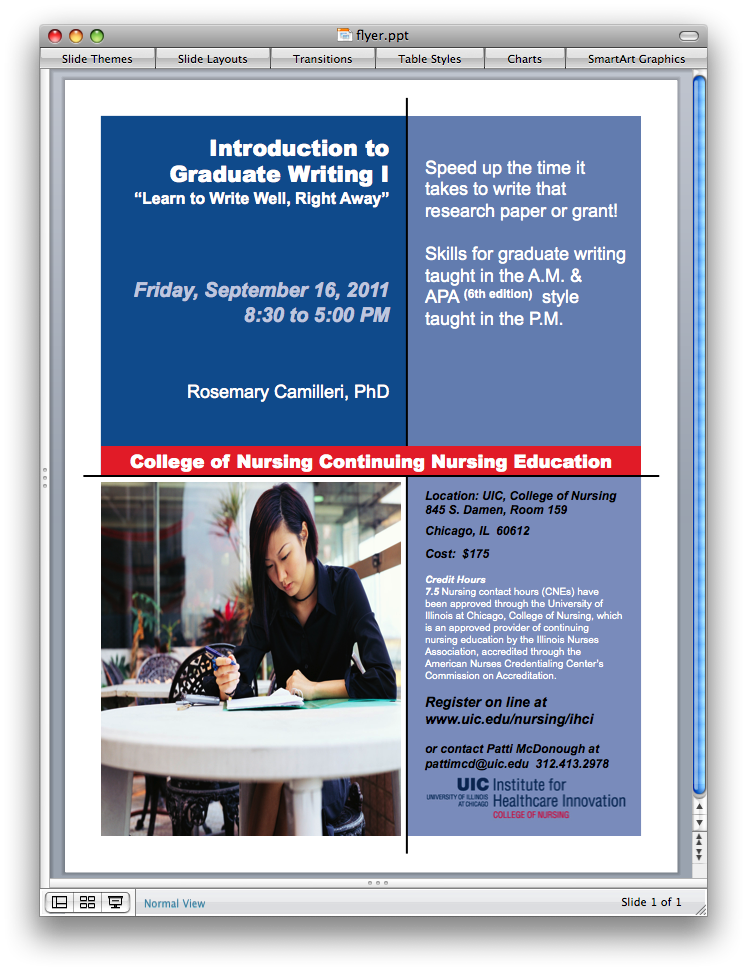
September 16, 2011: Writing Workshop

Term papers need not torment you.  If you write papers in APA 6th edition style, register for Rosemary's one-day workshop.  There are still spaces open on Friday, September 16, 2011, at University of Illinois at Chicago.  Class meets 8:30 to about 5:00 pm and cost is $175.  

Contact Rosemary at cseminar@uic.edu.

Rosemary will also present the workshop  Saturday, September 10, at Lewis University in Romeoville, IL 
and 
Saturday, September 24, at St. Anthony College in Rockford, IL.

Tuesday, June 07, 2011

Quotation Marks with Other Punctuation

Dr Paul Carvey, distinguished professor of pharmacology in Chicago, writes: 

I have been editing a lot of manuscripts, theses, dissertations, and term papers of late and have come across a common error made by our students involving the use of quotes and punctuation.  

Commas and periods almost invariably go inside the quotes, yet half the material I have read places the commas and periods outside of the quotes.  

I searched the Internet and looked at several writing guides, and all place the periods and commas inside the quotes.  Exclamation and question marks generally go inside the quotes as well, but it can depend on context in some cases.  Colons and semicolons generally go outside of quotes.  
The only time a period goes after a quote is when a citation follows the sentence (e.g., ….these results were found” (24).
 
Paul M. Carvey, PhD
Dean, Graduate College
Associate Dean of the Basic Sciences, Rush Medical College
The Deborah R. and Edgar D. Jannotta Presidential Professor of Pharmacology and Neuroscience

Thank you, Dr. Carvey!

Writers can learn more at the Purdue OWL (see item #5 especially).  Note, too, that the rule above applies to U.S. English.  British English, especially from the previous century, follows different rules for quotation. Currently the Concise Oxford English Dictionary, 11th edition, puts the comma before the end-quote, but it uses a single quote (') where U.S. English uses a double quotation mark.